
Temporary Gas Monitoring: Rental, Purchase and ESD Control
Updated: 7 minutes ago
Temporary gas monitoring gives operators visibility into supply pressure, delivery pressure and gas demand during construction, maintenance bypasses and temporary fuel-gas deployments. Burgess Pipeline Services offers BPS Gas Control rental, purchase and instrumentation retrofit options with project-specific remote access, alerts, data logging and optional ESD control.
BPS evaluates the gas run you already have, including manual systems that need instrumentation. Compatible equipment can be retained, with the final monitoring, valve-control, communications and power scope defined for the installation.

Gas monitoring features at a glance
Rental or purchase: Specify a package for a temporary project, repeat deployments or ongoing operation.
Pressure and optional flow: Monitor the regulator and gas demand on one configurable process display.
Remote access and alerts: Define who can view the system, change settings and receive notifications.
Optional ESD control: Integrate compatible valve actuation with commissioned local shutdown logic.
Power and records: Specify solar reserve, event history and data retention for the site.
Gas monitoring rental or purchase: choose your deployment
Rental is a practical option to evaluate when the monitoring requirement follows a defined job: a temporary fuel-gas supply, a pipeline maintenance period or a construction phase. The rental quote establishes the project dates, equipment availability, mobilization, installation, commissioning, service responsibilities and return terms.
Purchasing can suit equipment that will be used repeatedly or remain at a permanent location. A purchased monitoring package can be integrated into an existing mobile installation or specified as part of a dedicated system. The same project review establishes which measurements, remote functions and shutdown actions the installation needs.
The right choice depends on the deployment schedule, how often the system will be reused and the support the operator needs. BPS can quote rental and purchase scopes for comparison without assuming every job needs the same equipment.
Optional ESD control for high pressure and high flow
Emergency shutdown control is a separate function from simply displaying an alarm. A monitoring-only package reports a condition so that the operator can respond. An ESD-enabled package adds a specified local control response and compatible valve actuation for the conditions defined in the project design.
An installation may call for closing a valve on high downstream pressure, excessive measured flow or an authorized ESD-close command. Remote ESD-close can be included where the access permissions and control design allow it. The response must account for normal process changes, suitable thresholds, time delays, valve behavior and the operating procedure.
Local shutdown logic operates according to the commissioned cause-and-effect design.
A latched shutdown indication identifies a trip that requires the defined reset procedure.
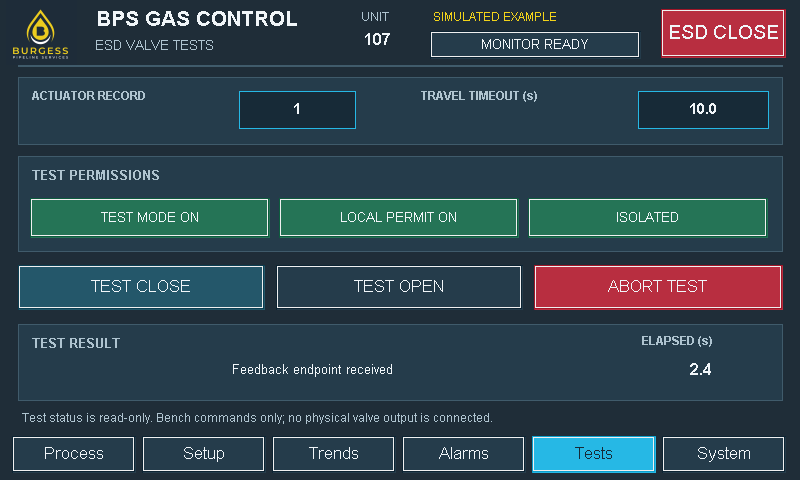
Valve-position feedback helps distinguish a close request from a confirmed closed position.
Controlled valve tests support commissioning and maintenance when the site’s test conditions are met.
Alarm acknowledgment, trip reset and permission to reopen the gas run are different actions. High-flow shutdown can respond to excessive flow, including some abnormal events, but it cannot be advertised as a detector for every line strike or leak. Mechanical protection and required operating procedures remain part of the installation.
Upstream pressure, downstream pressure and gas flow monitoring
Upstream pressure shows the available supply, while downstream pressure shows the delivery condition after regulation. Bringing both readings into the same display gives operators context when evaluating pressure changes or a supply complaint. Optional flow measurement adds visibility into gas demand and supports measured-flow alarms or shutdown logic.
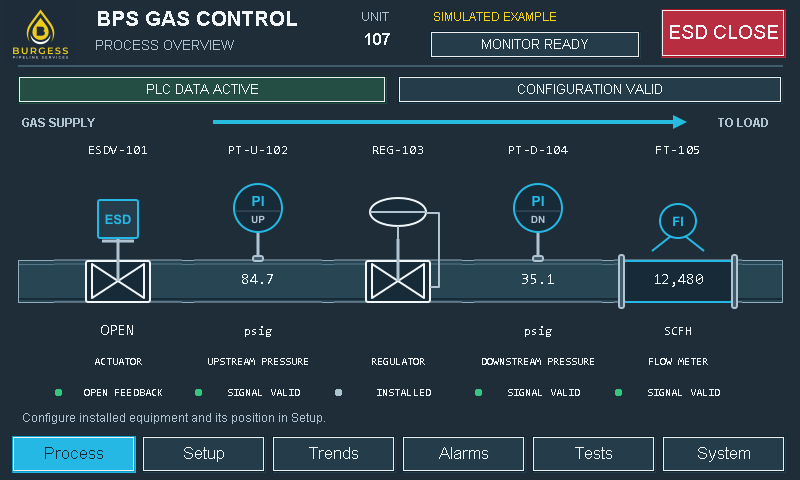
The BPS process interface uses a single pipeline run with five configurable equipment positions. Equipment tags move with their components when the order changes. Tags, installation status and the unit number can be edited for the job. Uninstalled components are removed from the process view so that unused readings do not clutter the screen. This is useful when a temporary unit moves between projects or its instrumentation changes.
Example: a temporary gas monitoring system
The illustrated unit 107 has five installed components: ESDV-101, PT-U-102, REG-103, PT-D-104 and FT-105. It represents a temporary regulated fuel-gas run with the shutdown valve open and pressure and flow signals available.
Upstream pressure: 84.7 psig at PT-U-102.
Downstream pressure: 35.1 psig at PT-D-104, after REG-103.
Gas flow: 12,480 SCFH at FT-105.
Valve status: ESDV-101 open with position feedback.
Secure remote gas monitoring from computers and phones
A remote operator should be able to review the configured process interface using an appropriate viewer on a computer, tablet or phone. BPS can include an encrypted VPN access path and authorized-user permissions in the project scope, with the connection tested for the selected devices and network.
Remote visibility and remote control are separate decisions. Some users may only need to view process information. Changing settings or issuing an ESD-close command requires the corresponding authorization. Multi-factor authentication can be specified at a compatible access gateway; the final security design identifies where authentication and permissions are enforced.
The connection may use cellular service or an available site network. Coverage, service subscriptions and support responsibilities are established in the quote. For ESD-enabled systems, the required local trip response does not depend on an operator first receiving an email. The design also defines the response to power loss and communications loss.

Gas monitoring alerts, live trends and data logging
A useful alert identifies the unit, the abnormal condition and the action expected of the recipient. Remote delivery of selected pressure, flow and equipment-fault alerts can be included through a separately configured notification service. Recipients and delivery testing are managed in that service.
Live trends show the selected equipment tag, engineering units and signal status, helping operators follow the correct measurement point. Recorded history helps the team review what happened afterward. The logging scope defines the measurements and events to record, sample interval, timestamps, storage, retention and export. Projects that need history during a connection outage should specify local retention and how those records will be recovered.
Solar-powered gas monitoring for remote sites
Solar and battery power can make monitoring practical at a remote site, but capacity depends on the complete load and the location. Adding flow measurement, a continuously energized solenoid or enclosure heating changes the daily energy requirement. The battery must support the agreed reserve period, while the array must carry normal loads and restore energy used during poor weather.
A mobile package that moves between sites should be checked against the next site’s sunlight, temperature, shading and operating requirements. BPS can evaluate an existing solar installation or quote a power package around the monitoring and control scope.
Pipeline instrumentation retrofits for existing gas systems
A retrofit begins with the actual pipeline rather than a fixed list of parts. BPS reviews the gas service, pressure and flow range, piping layout, installed equipment, available power and intended response to abnormal conditions. Compatible instruments may be retained, and additional monitoring points or valve integration can be specified where needed.
Applications include temporary natural gas supplies, construction and maintenance bypasses, regulator stations, industrial fuel-gas systems, remote odorization equipment and gas supplies serving generators or data centers. Compatibility and the final control scope are established for each installation.
What to include in your gas monitoring quote request
Is the system for a single temporary project, repeat deployments or a permanent installation?
What are the location, project dates, normal pressures and expected gas-flow range?
Which conditions should create an alert, and which should initiate an ESD?
Who needs remote viewing, settings access or permission to issue an ESD-close command?
How long should data be retained, and what reports or exports are needed?
Is power available, or should the quote include solar and battery reserve?
Frequently asked questions
Can I rent without automatic shutdown?
Yes. A monitoring-only rental scope can be evaluated. ESD control is separately specified and requires compatible valve actuation and a commissioned shutdown design.
Can a purchased unit be adapted for a different job?
The display and configured monitoring points can be adapted, with the new installation reviewed for instrumentation compatibility, power capacity, communications and control requirements.
Request a temporary gas monitoring rental or purchase quote
Tell BPS what you need to monitor, how long the deployment will last and what should happen when conditions change. Ask about temporary gas monitoring rental, a purchased mobile package or an instrumentation retrofit with ESD integration for your existing system.


